

TOKYO CREATIVE SALON 2026: ‘Future Vintage’ Spices Up the Citywide Festival of Creativity
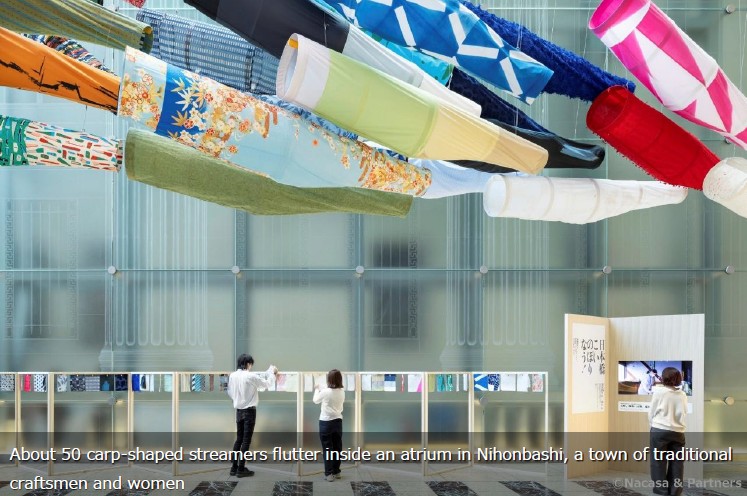
About 50 carp-shaped streamers flutter inside an atrium in Nihonbashi, a town of traditional craftsmen and women
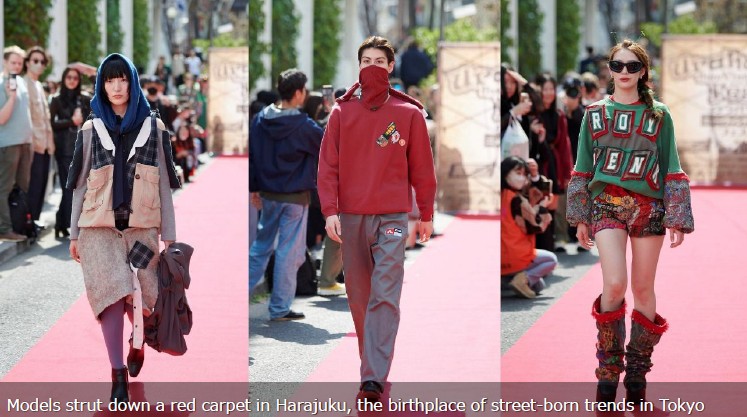
Models strut down a red carpet in Harajuku, the birthplace of street-born trends in Tokyo
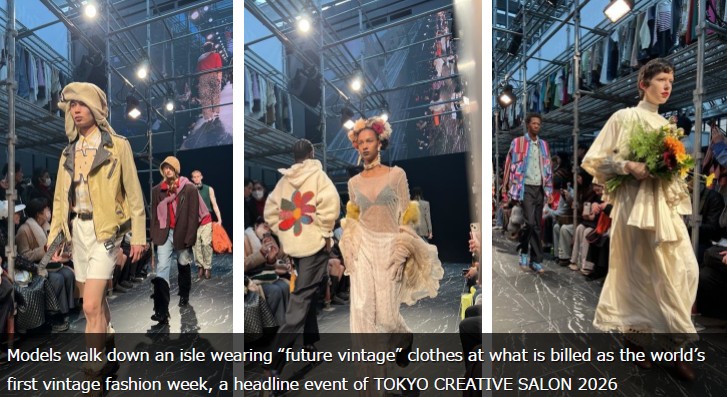
Models walk down an isle wearing “future vintage” clothes at what is billed as the world’s first vintage fashion week, a headline event of TOKYO CREATIVE SALON 2026

A moving hologram of real-life geisha Akasaka Ikuko, 86, greets visitors to an exhibit in Akasaka, a traditional nightlife district.

The Grand Prize winners of the Next Fashion Designer of Tokyo (NFDT) and Sustainable Fashion Design Award (SFDA) competitions
TOKYO, JAPAN, April 28, 2026 /EINPresswire.com/ -- About 100 secondhand clothing booths lined up for the “world’s first vintage fashion week.” A moving hologram of a real-life 86-year-old geisha in kimono greeted visitors to an exhibition of cultural heritage in a traditional nightlife district.
It was so diverse and ingenious. TOKYO CREATIVE SALON—an annual festival of fashion, design and various other forms of creative expressions—unfolded across nine iconic districts including Ginza in its seventh edition. And as always, this springtime event was surrounded by early cherry blossoms.
The forward-looking theme of “FUTURE VINTAGE” defined TOKYO CREATIVE SALON 2026 (TCS 2026) held March 13-22. The festival featured a smorgasbord of fashion shows (notably street runways), exhibitions, workshops, flea markets, participatory programs and performances—many focusing on tradition and sustainability. The theme was subtitled “Carrying the past into the future through new creation.”
Website: TOKYO CREATIVE SALON 2026
https://tokyo-creativesalon.com/en/
Establishing Tokyo as a Global ‘Hub for Fashion and Creativity’
“We aim to blend Tokyo’s tangible and intangible assets to distinguish itself from world-leading (creative) cities like New York and Milan,” TCS 2026 Chairman Onishi Hiroshi told the event’s opening ceremony, citing Tokyo’s pride in its “art, design, fashion, craft and others.”
Having grown into one of Japan’s largest festivals of creativity, Tokyo Creative Salon took place across Marunouchi, Nihonbashi, Ginza, Akasaka, Roppongi, Shibuya, Harajuku, Shinjuku and Haneda this year. These districts—traditional, trendy or both—are located not so far from each other in the center of the megacity of 14 million, except for the waterfront airport of Haneda.
Tokyo Governor Koike Yuriko told the ceremony that many international travelers are strongly attracted by “the city of Tokyo, its culture and creativity.” “To seize this opportunity and establish Tokyo’s presence on the global stage as a hub for fashion and creativity,” she said, “it is essential to leverage the unique character of each district and promote the city as a whole.”
Her administration has been supporting the festival as a partner and promoter. TCS was launched in 2020 with the aim of cementing Tokyo’s place among the world’s top five fashion capitals alongside Paris, Milan, New York and London.
Tokyo Creative Salon also engages giant retailers, real estate developers and other private companies, as well as industry organizations and local communities in its organization.
The number of visitors to the 2026 edition was announced as about 1.3 million.
Tokyo Has a ‘Culture All Its Own’: Street and Vintage
Billed as the world’s first, Tokyo Vintage Fashion Week took the center stage of the 10-day festival. A total of 107 booths from 83 major Japanese and overseas vintage dealers crowded a market set up in a cavernous hall in the west of Shinjuku, a business and entertainment hub in the capital.
The market was held for three days and coupled with two fashion shows, one for regular secondhand clothes and the other for vintage items with futuristic tweaks. It drew 18,623 visitors. Among the merchandise on sales were rare items such as a Raf Simons MA1 bomber jacket priced at 5,940,000 yen (about 37,000 dollars).
Proceeds from the vintage market were estimated at some 87,035,000 yen (546,000 dollars), according to the organizers.
“While the West has created luxury and refined its value, Tokyo has a culture all its own,” said TCS Fashion Director Matsui Tomonori. “I believe this is embodied in street fashion and vintage clothing, and in the accumulation of sensibilities passed down from person to person across the ages.”
Also in Shinjuku—home to pop culture, pockets of counter culture and several fashion schools—local students did a catwalk at a park outside Shinjuku Station, wearing apparel they recycled from used clothes that were dyed by local craftsmen. The show was themed on cherry blossoms, and the cherry flowers there were just beginning to bloom.
One of the Shinjuku schools is century-old Bunka Fashion College whose alumni include renowned couturiers Takada Kenzo and Yamamoto Yohji. Japan has also produced other world-class fashion designers, including pioneers such as Mori Hanae, Kawakubo Rei and Miyake Issey.
Meet a Real-Life Geisha (Through a Hologram)
Akasaka, a midtown social hub for sophisticated adults including politicians and business executives, offered artifacts and digital technologies to help revisit its history of some 280 years as a nightlife spot.
Akasaka Ikuko, 86, has served for 66 years and is still active as a geisha—a Japanese woman whose profession is to entertain customers with conversation and singing and dancing at banquets and exclusive settings. The number of geisha is dwindling, as are high-end traditional restaurants.
Her life-size moving hologram inside a transparent “holobox” bowed and welcomed visitors to an exhibition of geisha paraphernalia—kimonos, combs, hairpins, clogs and such—along with floats and other crafts from a local Shinto shrine. The exhibition took place at a high-rise business and commercial tower.
Ikuko’s movements, recorded in 3D motion data, were projected onto an interactive art screen outside a subway gate in the “AKASAKA Motion Heritage” program.
Street-Smart Shibuya and World’s Ethnic Cultures Cross Paths
In Shibuya, the fashion-conscious youth town now under a new phase of redevelopment and famed for its all-direction “Scramble Crossing,” Tokyo Creative Salon merged into the 25th semiannual Shibuya Fashion Week.
Amid the beehive of activities by vendors, many of whom were lined up with major designers and influencers and collaborating with large commercial facilities, stood a solo exhibition of about 100 photographs that capture daily lives of people in 12 countries clad in ethnic clothes.
The pictures in the exhibition titled “Threads of Beauty” were all taken over 30 years by Takagi Yuriko, a UK-educated Japanese designer-turned-photographer. The show featured a video, which compared “Threads of Beauty” photos with video images shot by her in modern Shibuya.
“By presenting side-by-side the images of people from 12 different countries and those of people I photographed at the Shibuya intersection, I wanted you to gain some insight into the phenomena occurring simultaneously across society today,” she told the GQ Japan magazine. India, China, Iran, Ethiopia, Peru and Mexico are among the countries she visited.
In the neighboring district of Harajuku—known as the birthplace of street-born trends and the global kawaii (cuteness) craze—models for emerging creators including KAWAII.LAB. walked down a red carpet rolled over a narrow path called Cat Street.
Deadstock Turns into ‘Live Stock’
Nihonbashi, a town of traditional craftsmanship for centuries, is located half an hour walk from the Imperial Place, the former site of the Tokugawa shoguns’ castle. About 50 carp-shaped Koinobori streamers were hung together inside an atrium at a high-rise emporium.
Textile designer Sudo Reiko created the colorful streamers for the second straight year in collaboration with local workshops using kimono fabric, washi paper and traditional hand towels. Koinobori, meaning rising carp in Japanese, have been customarily hoisted to wish for the healthy growth of children in Japan.
In the neighboring district of Marunouchi, regarded the nation’s premier business district, deadstock clothes were upcycled and sold at “Live Stock Market” set up at different well-established retail stores. Fabric scraps stored at apparel companies such as UNITED ARROWS and BEAMS were manufactured into bags and presented to “Live Stock Market” stamp rally participants.
Ginza, reputed as the top-brand destination for shopping, wining and dining, had too much to offer, ranging from classical Noh theater to world-famous denim from western Japan woven with three-dimensional embroidery from a region north of Tokyo.
Noh actor Kanze Saburota, 26, danced for half an hour at a Noh theater in Ginza free of charge. He chose the same play as last year—a classical fable about townspeople visiting a remote mountain covered with cherry blossoms and encountering celestial beings.
Roppongi, an upmarket neighborhood where all sorts of night people like to party, and Haneda International Airport by Tokyo Bay, the gateway to the world, contributed to TCS 2026 with independent fashion, design and art programs.
Tokyo Catapulting Young Talent into the Global Spotlight
In a tie-up with TCS 2026, the Tokyo Metropolitan Government (TMG) organized two annual fashion competitions for the fourth time to discover and nurture up-and-coming talent who are promising to make their mark on the global stage.
One of them, the “Next Fashion Designer of Tokyo” contest, engages students living or studying in Tokyo in “free” and “inclusive design” categories. The other, “Sustainable Fashion Design Award,” is contested in “wear” and “fashion goods” categories among Tokyo-based amateur designers who reuse kimono and other fabrics for their works.
Winners will receive prize money and support from the TMG in launching their brands and finding an opportunity to present their works during the Paris Fashion Week, and other benefits.
On March 29, Grand Prizes were awarded in four categories after the final judging in the format of a fashion show. The Inclusive Design Grand Prize went to Bunka Fashion College student Nanami MacFarlane. Her work, titled “Unbalanced beauty,” consists of three white dresses with bold red lines and openings that allow for smooth dressing and undressing from any point.
MacFarlane explained that her experience with a congenital hand deformity had inspired a “design that would unify the body and clothing as one.” “Rather than hiding disabilities, it proposes a new fashion that celebrates them as individuality and transforms them into a source of confidence.”
Apart from Grand Prizes, there are two excellent awards and a special select award in each category. Tokyo Governor Koike told the award ceremony that of all the award winners in the past 43 have been “active in the fashion world” and 37 have “launched their own brands.”
“I believe Tokyo is truly a global hub for fashion,” she said, “and a vital place for nurturing talent.”
Strategic PR Section, Strategic PR Division
TOKYO METROPOLITAN GOVERNMENT
email us here
Legal Disclaimer:
EIN Presswire provides this news content "as is" without warranty of any kind. We do not accept any responsibility or liability for the accuracy, content, images, videos, licenses, completeness, legality, or reliability of the information contained in this article. If you have any complaints or copyright issues related to this article, kindly contact the author above.
