

Your daily news update on the United Kingdom
Provided by AGP
A smarter way to predict how tall girls will grow after menarche
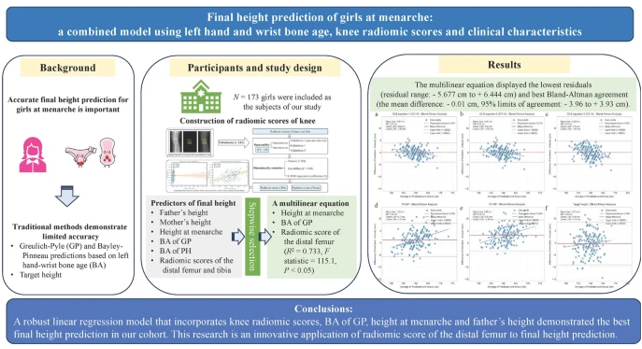
A new model for predicting final height after menarche.
FAYETTEVILLE, GA, UNITED STATES, May 9, 2026 /EINPresswire.com/ -- For girls who have just reached menarche, the window for meaningful height intervention is short, but predicting how much growth remains has long been imprecise. A new study offers a more accurate way to estimate final height by combining traditional bone age assessment with quantitative image features from the knee and key clinical measures.
Menarche marks a major turning point in female development and usually signals that only limited height gain remains. However, the remaining growth varies widely from girl to girl, making clinical decisions difficult. Conventional methods such as the Greulich-Pyle and Bayley-Pinneau approach depend heavily on hand-wrist bone age, even though final stature is strongly tied to lower-limb growth. The knee, especially the distal femur and proximal tibia, may better reflect ongoing growth because these regions fuse later than the hand and wrist do. Manual readings also introduce observer variation. Owing to these challenges, in-depth research is needed on more objective and accurate methods for predicting final height after menarche.
Researchers from Shanghai Children’s Medical Center, Shanghai Jiao Tong University School of Medicine, reported (DOI: 10.1007/s12519-025-01002-5) the study online on December 13, 2025, in World Journal of Pediatrics. The team analyzed 173 Chinese girls seen within three months of menarche and developed a prediction model that combined height at menarche, father’s height, Greulich-Pyle bone age, and a radiomic score derived from left knee images. Their goal was to improve final height prediction at a stage when decisions about possible intervention are especially time sensitive.
To construct the model, researchers extracted radiomic features from digital radiographs of the left knee, focusing on the distal femur and proximal tibia. These features captured image patterns related to shape, brightness, and texture that are not readily visible in routine clinical readings. After feature screening and regression analysis, the distal femur score emerged as a useful imaging marker, whereas the tibial score did not significantly correlate with the final height. In this cohort, girls gained an average of 8.94 cm after menarche. The best-performing equation explained approximately 73% of the variation in final height and outperformed traditional methods in fivefold cross-validation. Its prediction errors were narrower, with a root mean square error of approximately 2.01 cm and strong Bland-Altman agreement, whereas older approaches resulted in larger residuals and more systematic bias.
“This study points to a more practical way of reading growth potential at menarche: not by relying on one familiar atlas alone but by combining clinical judgment with hidden imaging signals from the knee. The distal femur appears to preserve information about maturation that standard assessment may miss, making final height prediction more stable, more objective, and potentially more useful when families and clinicians must decide quickly whether intervention is still worthwhile.”
These findings could help pediatric endocrinology move toward more individualized prediction tools for girls entering the final phase of growth. Because digital radiography of the knee is far more practical than magnetic resonance imaging in outpatient care, the model may be easier to translate into routine clinics. It may also reduce the subjectivity in bone age interpretation, especially when expert readers are limited. The authors note that the study was based on a single-center Chinese cohort and still needs broader external validation. Even so, the work suggests that radiomics could turn ordinary radiographs into richer decision tools for growth assessment and adolescent care.
References
DOI
10.1007/s12519-025-01002-5
Original Source URL
https://doi.org/10.1007/s12519-025-01002-5
Funding Information
This study was supported by the Shanghai Oriental Talents Program-Youth Project (QNWS2024011) and the Fundamental Research Funds for the Central Universities (YG2023QNA35).
Lucy Wang
BioDesign Research
email us here
Legal Disclaimer:
EIN Presswire provides this news content "as is" without warranty of any kind. We do not accept any responsibility or liability for the accuracy, content, images, videos, licenses, completeness, legality, or reliability of the information contained in this article. If you have any complaints or copyright issues related to this article, kindly contact the author above.
