
Your daily news update on the United Kingdom
Provided by AGP
UV Curing Lamps Market to Reach US$ 5.4 Billion by 2033, Growing at 9.3% CAGR from 2026–2033
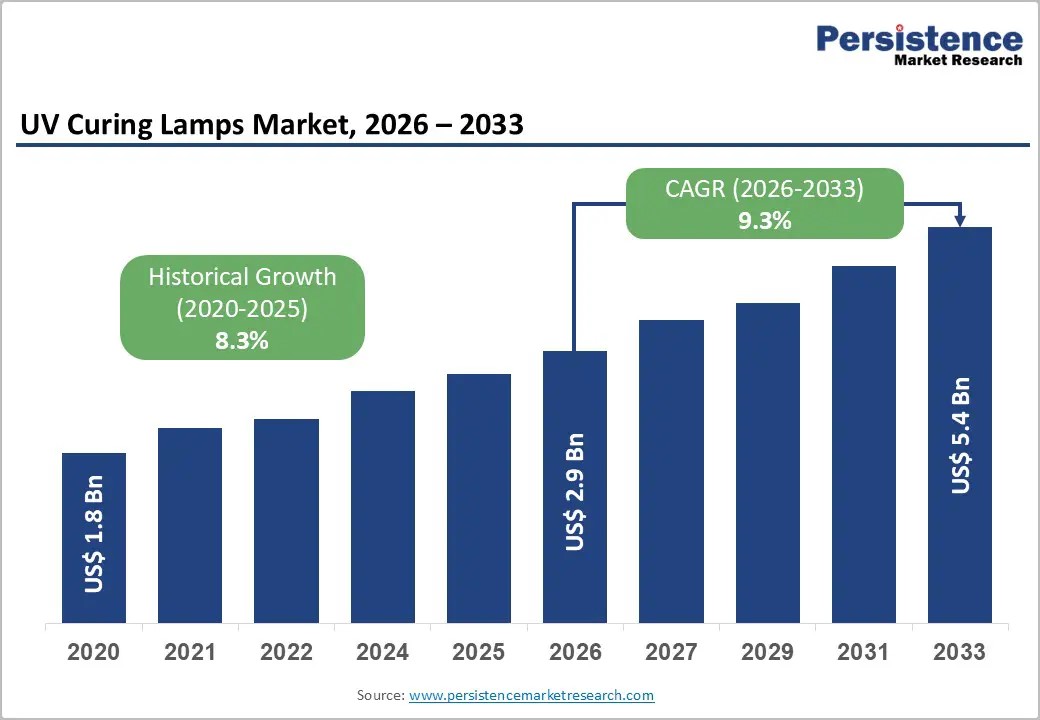
The UV curing lamps market to rise from US$2.9 Bn in 2026 to US$5.4 Bn by 2033 at 9.3% CAGR, fueled by demand in printing, coatings and electronics
BRENTFORD, ENGLAND, UNITED KINGDOM, May 13, 2026 /EINPresswire.com/ -- The global UV curing lamps market is experiencing steady and structurally reinforced growth, driven by the transition toward high-efficiency, low-emission manufacturing systems across multiple industrial verticals. Valued at US$ 2.9 billion in 2026, the market is projected to reach US$ 5.4 billion by 2033, expanding at a CAGR of 9.3% during the forecast period. This growth is closely linked to increasing industrial demand for faster curing cycles, improved production throughput, and reduced environmental footprint across printing, coating, electronics, automotive, and healthcare manufacturing applications. The shift from conventional solvent-based systems toward ultraviolet curing technologies reflects broader sustainability mandates and tightening global emission regulations.
A key growth catalyst is the rapid advancement of LED-based UV curing systems, which offer superior energy efficiency, longer operational life, and reduced thermal impact compared to traditional mercury vapor lamps. These technological improvements are accelerating equipment replacement cycles across industrial production lines. Asia Pacific leads the global market with approximately 40% share in 2026, supported by large-scale manufacturing ecosystems and electronics production hubs. Meanwhile, industrial manufacturing remains the dominant end-user segment due to its extensive reliance on high-speed, precision-driven curing processes. Together, these dynamics are reshaping UV curing from a niche industrial tool into a core enabling technology for modern automated manufacturing systems.
𝐆𝐞𝐭 𝐚 𝐒𝐚𝐦𝐩𝐥𝐞 𝐏𝐃𝐅 𝐁𝐫𝐨𝐜𝐡𝐮𝐫𝐞 𝐨𝐟 𝐭𝐡𝐞 𝐑𝐞𝐩𝐨𝐫𝐭: https://www.persistencemarketresearch.com/samples/16486
Market Segmentation of UV Curing Lamps Market
The UV curing lamps market is segmented by product type, end-user industry, and application. By product type, it includes mercury vapor lamps and LED UV curing lamps. Mercury lamps still hold a major share due to their established use in printing and coating applications, while LED UV lamps are growing rapidly due to energy efficiency, longer lifespan, and mercury-free operation.
By end-user industry, the market includes industrial manufacturing, electronics, automotive, healthcare, packaging, and others. Industrial manufacturing leads the market due to wide use in coatings and adhesives, while electronics is the fastest-growing segment driven by miniaturization and precision assembly needs.
Regional Insights of the UV Curing Lamps Market
Asia Pacific dominates the market due to strong manufacturing bases in China, Japan, South Korea, and India, along with high adoption in electronics and automotive sectors. North America follows with strong demand from aerospace, medical, and advanced manufacturing industries supported by automation and strict regulations.
Europe shows steady growth driven by sustainability regulations and early adoption of mercury-free systems, especially in Germany, the U.K., and France. Latin America and the Middle East & Africa are emerging regions, gradually increasing adoption as industrial modernization expands.
𝐃𝐨 𝐘𝐨𝐮 𝐇𝐚𝐯𝐞 𝐀𝐧𝐲 𝐐𝐮𝐞𝐫𝐲 𝐎𝐫 𝐒𝐩𝐞𝐜𝐢𝐟𝐢𝐜 𝐑𝐞𝐪𝐮𝐢𝐫𝐞𝐦𝐞𝐧𝐭? 𝐑𝐞𝐪𝐮𝐞𝐬𝐭 𝐂𝐮𝐬𝐭𝐨𝐦𝐢𝐳𝐚𝐭𝐢𝐨𝐧 𝐨𝐟 𝐑𝐞𝐩𝐨𝐫𝐭: https://www.persistencemarketresearch.com/request-customization/16486
Market Drivers
The UV curing lamps market is primarily driven by the global shift toward sustainable and energy-efficient manufacturing systems. Regulatory pressure to reduce volatile organic compound (VOC) emissions is pushing industries to adopt UV-based curing solutions that eliminate solvent dependence and reduce environmental impact. Additionally, rising demand for high-speed production processes is accelerating adoption, as UV curing significantly reduces drying and curing time compared to conventional thermal methods. This improves productivity, lowers operational costs, and enhances manufacturing throughput across multiple industries.
Technological advancements in LED UV systems are another major driver, enabling precise wavelength control, reduced energy consumption, and longer operational lifespans. Integration with automated production lines and Industry 4.0 systems further enhances adoption by enabling real-time process control and quality monitoring. These innovations are transforming UV curing from a supplementary process into a core industrial technology embedded in modern smart factories.
Market Restraints
Despite strong growth prospects, the UV curing lamps market faces several restraints that limit widespread adoption. One of the primary challenges is the high initial capital investment required for UV curing systems, including equipment upgrades, facility modifications, and integration with existing production lines. For small and medium manufacturers, these costs can delay adoption and extend return-on-investment timelines. Retrofitting legacy systems also introduces operational disruptions, further increasing implementation complexity.
Another significant restraint is material compatibility limitations. Many substrates, coatings, and adhesives require reformulation to function effectively under UV wavelengths, adding development costs and extending product qualification cycles. Additionally, stringent safety regulations surrounding UV exposure necessitate protective systems, training, and compliance monitoring, increasing operational overhead for manufacturers.
Market Opportunities
The expanding electronics and medical device industries present substantial growth opportunities for UV curing technologies. As electronics manufacturing shifts toward miniaturization and high-density assembly, UV curing provides low-temperature, precision-based processing ideal for sensitive components. This makes it essential for semiconductor packaging, PCB assembly, and advanced device manufacturing.
Similarly, the medical sector increasingly relies on UV curing for adhesives, coatings, and sterilization-compatible applications that require high precision and regulatory compliance. The rise of advanced materials manufacturing, including functional coatings and engineered polymers, further expands opportunities. Additionally, the ongoing transition toward mercury-free technologies is accelerating replacement cycles, creating sustained demand for LED-based UV curing systems globally.
𝐁𝐮𝐲 𝐍𝐨𝐰 𝐭𝐡𝐞 𝐃𝐞𝐭𝐚𝐢𝐥𝐞𝐝 𝐑𝐞𝐩𝐨𝐫𝐭: https://www.persistencemarketresearch.com/checkout/16486
Company Insights
• Heraeus Covantics
• Phoseon Technology
• IST METZ GmbH & Co. KG
• Excelitas Technologies Corp.
• Dymax
• Panasonic Industry Co., Ltd.
• Nordson Corporation
• BW Converting
• Hoenle AG
• Ushio Inc.
Conclusion
The UV curing lamps market is entering a strong growth phase, supported by sustainability mandates, technological innovation, and the global transition toward high-efficiency manufacturing systems. The rapid adoption of LED-based UV curing solutions is fundamentally reshaping production environments by reducing energy consumption, improving process precision, and enabling mercury-free operations. While challenges such as high upfront costs and material compatibility remain, ongoing innovation and regulatory pressure are accelerating adoption across industries. With strong demand from electronics, automotive, healthcare, and advanced materials manufacturing, UV curing technology is set to play a critical role in the future of industrial production through 2033.
Related Reports:
Pooja Gawai
Persistence Market Research
+1 646-878-6329
email us here
Visit us on social media:
LinkedIn
Instagram
Facebook
YouTube
X
Legal Disclaimer:
EIN Presswire provides this news content "as is" without warranty of any kind. We do not accept any responsibility or liability for the accuracy, content, images, videos, licenses, completeness, legality, or reliability of the information contained in this article. If you have any complaints or copyright issues related to this article, kindly contact the author above.
