
Hot Dip Galvanized Iron Wire Market to Grow from $3,483.760 Billion in 2025 to $6,030.130 Billion by 2035 at 5.10% CAGR
Hot Dip Galvanized Iron Wire Market (2026 - 2035)
North America hot-dip galvanized iron wire market is the dominant region by 2025 revenue on the strength of infrastructure reauthorization spending
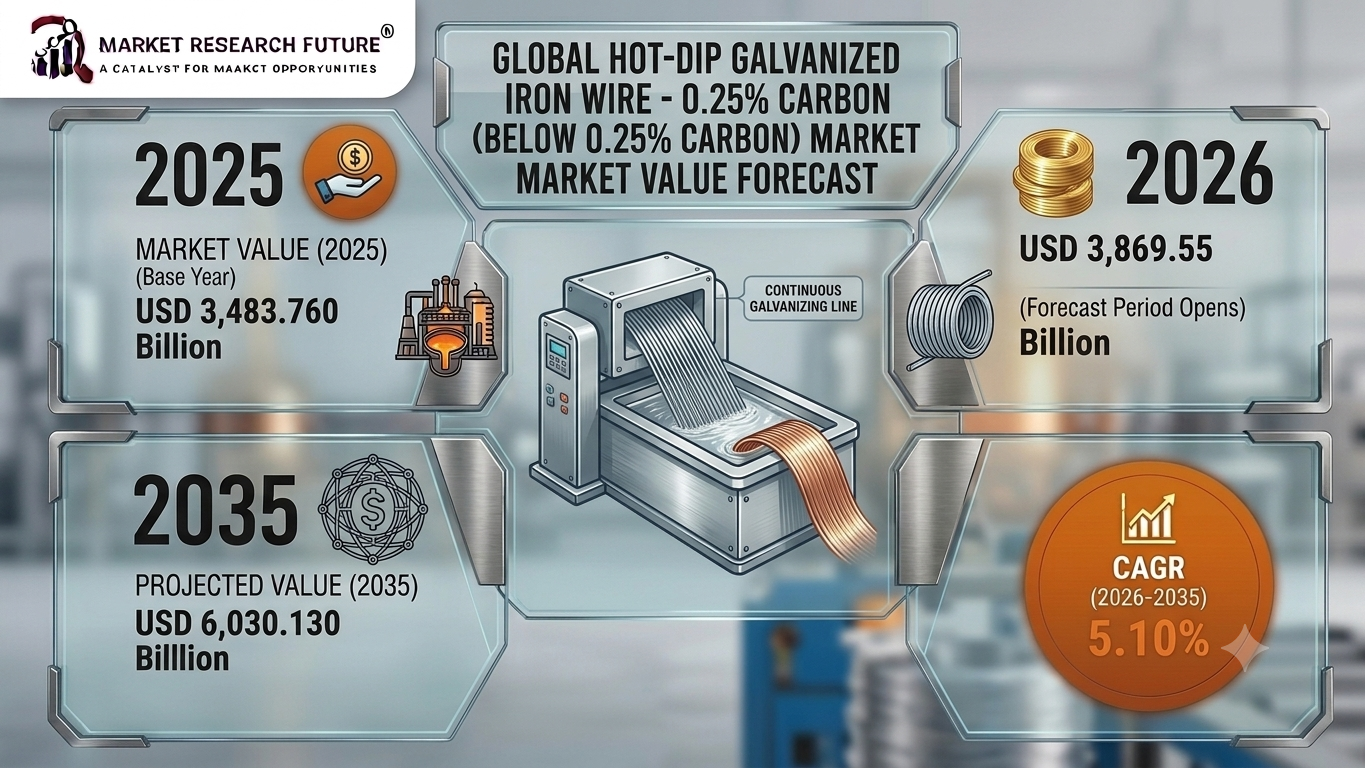
GA, UNITED STATES, August 31, 2026 /EINPresswire.com/ -- The global Market is gaining steady momentum as infrastructure development, renewable energy expansion, agricultural modernization, and industrial activity increase demand for durable corrosion-resistant wire products. Hot-dip galvanized iron wire is widely used in fencing, gabion structures, erosion-control systems, binding wire, cable armoring, and industrial wire products.According to Market Research Future, the global Hot Dip Galvanized Iron Wire Market was valued at USD 3,483.760 billion in 2025 and is projected to reach USD 6,030.130 billion by 2035, expanding at a 5.10% CAGR during 2026–2035. The market is expected to reach approximately USD 3,869.55 billion in 2026, establishing a steady growth trajectory through the forecast period.
Infrastructure Development Strengthens Market Demand
Infrastructure investment is one of the most important factors supporting the Hot Dip Galvanized Iron Wire Market. Galvanized wire is incorporated into highway fencing, guardrail mesh, retaining structures, reinforcement systems, perimeter security, and other civil infrastructure applications.
Long-term investments in roads, bridges, railways, utilities, and urban infrastructure are generating consistent demand for corrosion-resistant wire products. The durability of galvanized coatings makes these products particularly valuable for outdoor infrastructure exposed to moisture and changing weather conditions.
North America is benefiting from infrastructure spending and transmission development, while Asia-Pacific is experiencing strong demand from urbanization, industrialization, and rural infrastructure projects.
Renewable Energy Creates New Opportunities
The expansion of renewable energy infrastructure is creating additional opportunities for galvanized iron wire manufacturers. Solar farms, wind farms, substations, and transmission infrastructure require fencing, mesh, grounding components, and cable-protection systems.
Power-grid modernization is particularly important because galvanized wire is used in cable armoring and other applications associated with electrical infrastructure.
As countries increase investment in renewable electricity and transmission networks, demand for durable wire products is expected to rise. The continued expansion of power infrastructure is therefore becoming an increasingly important growth driver for the market.
Agricultural Infrastructure Supports Fencing Demand
Agriculture represents another major application area for galvanized iron wire. Fencing is used for livestock containment, crop protection, orchards, vineyards, land boundaries, and agricultural infrastructure.
Agricultural mechanization and food-security programs are encouraging investment in permanent fencing and related infrastructure. This trend is particularly relevant in Asia-Pacific, Latin America, and the Middle East and Africa.
The durability and corrosion resistance of galvanized wire make it suitable for agricultural environments where products may remain exposed to weather conditions for extended periods.
Request Free Sample Copy: https://www.marketresearchfuture.com/sample_request/68399
Heavy Coating Products Gain Importance
The market is segmented by coating type into Light Coating and Heavy Coating. Heavy coating products represent the dominant category by revenue because higher coating mass can provide improved corrosion protection and longer service life.
Heavy-coated wire is particularly relevant for infrastructure, industrial, marine, and other demanding applications where long-term durability is important.
At the same time, light coating products remain important for cost-sensitive applications such as certain fencing and binding-wire uses. The balance between coating thickness, product life, zinc consumption, and price continues to influence purchasing decisions.
Medium Wire Maintains Market Leadership
By wire diameter, the market is divided into Fine Wire (Below 1 mm), Medium Wire (1–4 mm), and Thick or Heavy Wire (Above 4 mm).
Medium wire, ranging from 1 to 4 mm, currently represents the dominant diameter class. Its broad use across fencing, gabion structures, mesh, and general industrial applications supports its strong market position.
Fine wire below 1 mm is expected to record faster incremental growth as manufacturers increasingly use galvanized wire in cable armoring, precision mesh, and specialized industrial fabrication.
Thick or heavy wire remains important for structural applications, erosion-control systems, marine gabions, and heavy-duty binding requirements.
Fencing Remains the Leading Application
Fencing is currently the dominant application segment in the global market. Galvanized iron wire is widely used in agricultural fencing, highway fencing, perimeter security, livestock management, and property boundaries.
Demand for fencing is closely connected to infrastructure development and agricultural activity. Government projects involving roads, railways, utilities, and public facilities frequently require durable perimeter and security systems.
Industrial Wire Products, meanwhile, represent a faster-growing application category. Increasing substitution of galvanized feedstock into downstream fabricated products is creating new opportunities for wire manufacturers.
Buy Now: https://www.marketresearchfuture.com/checkout?currency=one_user-USD&report_id=68399
Gabion and Erosion Control Applications Expand
Gabion and erosion-control systems are another important demand area. Galvanized wire is used to manufacture wire mesh structures filled with rocks or other materials to stabilize slopes, protect riverbanks, and control soil erosion.
Growing concerns about flooding, landslides, coastal erosion, and infrastructure resilience are encouraging governments and developers to invest in erosion-control systems.
Infrastructure projects located in mountainous or flood-prone areas can therefore create additional demand for heavy-duty galvanized wire products.
Cable Armoring Benefits from Grid Modernization
Cable armoring represents a specialized but increasingly important application. Galvanized wire can provide mechanical protection for underground, submarine, and heavy-duty electrical cables.
As electricity grids are upgraded and renewable power generation expands, the need for reliable transmission and distribution infrastructure is increasing.
The expansion of underground and submarine cable networks creates opportunities for fine and medium galvanized wire products. Grid modernization is therefore expected to remain an important long-term market driver.
Manufacturing Technology Improves Product Performance
Technological advancements in galvanizing and wire manufacturing are changing the competitive landscape. Manufacturers are adopting improved flux chemistry, coating-control systems, induction preheating, alloyed zinc baths, and automated coating measurement.
These technologies can improve coating consistency while reducing unnecessary zinc consumption.
Because zinc represents a significant component of production costs, improvements in coating efficiency can help manufacturers increase margins while maintaining required corrosion-protection performance.
Advanced manufacturing systems can also help producers meet demanding standards and deliver consistent products for infrastructure and industrial customers.
Green Steel Gains Strategic Importance
Sustainability is becoming increasingly relevant to galvanized wire production. Steel manufacturers and wire producers are under pressure to reduce carbon emissions, improve energy efficiency, and manage production waste.
The development of green steel and lower-carbon production pathways can help reduce the embedded environmental footprint of galvanized wire.
Manufacturers are also exploring more efficient galvanizing processes, optimized zinc usage, recycling, and improved waste management. These initiatives are expected to become increasingly important as customers and governments introduce stricter environmental requirements.
Raw Material Costs Remain a Challenge
Despite positive growth prospects, raw material price volatility remains a major challenge. Producers are exposed to fluctuations in the prices of both low-carbon wire rod and zinc.
Changes in zinc prices can directly influence production costs and final product prices. Cost-sensitive customers may respond to higher zinc prices by choosing lighter coating grades where application requirements permit.
Supply-chain disruptions can also affect availability and pricing of raw materials. Manufacturers with reliable sourcing networks and efficient inventory management may therefore have an advantage in a volatile market environment.
Report Summary: https://www.marketresearchfuture.com/reports/hot-dip-galvanized-iron-wire-market-68399
Environmental Regulations Influence Production
Galvanizing involves processes such as pickling, fluxing, zinc coating, and the management of zinc ash and dross. Environmental regulations governing emissions, wastewater, chemicals, and energy use are becoming increasingly stringent.
Compliance requirements can increase capital expenditure for producers, particularly older facilities that require modernization.
At the same time, regulatory pressure can encourage technological innovation. Companies investing in energy-efficient equipment, improved process controls, recycling systems, and cleaner production technologies can strengthen their long-term competitiveness.
North America Leads the Regional Market
North America currently represents the dominant regional market for hot-dip galvanized iron wire. Infrastructure spending, transmission-grid modernization, and domestic manufacturing support demand across the region.
The United States is particularly important because of investments in infrastructure and power networks. Demand from fencing, construction, utilities, and industrial applications supports the regional market.
Domestic manufacturing capacity and trade policies may also influence supply chains and competitive dynamics in the region.
Asia-Pacific Records Strong Growth Potential
Asia-Pacific is projected to be the fastest-growing regional market. The region benefits from rapid industrialization, urbanization, infrastructure development, agricultural modernization, and the concentration of global wire-drawing and galvanizing capacity.
China, India, and Southeast Asian countries are particularly important markets. Expanding electricity grids, transportation infrastructure, rural development, and construction activity are generating significant demand.
The region's growing manufacturing base also supports downstream applications, including industrial wire products and cable armoring.
Europe Focuses on Efficiency and Decarbonization
Europe represents an important market but faces stronger cost and environmental pressures. The region's emphasis on decarbonization, carbon reporting, and sustainable manufacturing is influencing galvanized wire producers.
Manufacturers are increasingly investing in efficient galvanizing systems and lower-carbon steel inputs to meet evolving requirements.
The emphasis on long-service-life infrastructure also supports demand for heavy-coated products that can reduce maintenance requirements over extended operating periods.
Competitive Landscape
The global market includes major companies such as N.V. Bekaert S.A., ArcelorMittal S.A., Tata Steel Limited, Tianjin Huayuan Metal Wire Products Co., Ltd., and Nucor Corporation.
Competition is centered on coating quality, production efficiency, product consistency, pricing, geographic reach, and technical capabilities.
Leading manufacturers are increasingly investing in advanced galvanizing technology, capacity expansion, sustainable production, and higher-performance coating systems.
Strategic consolidation and regional expansion are also shaping the competitive environment as companies seek to strengthen their positions in growing infrastructure and industrial markets.
Related Report
galvanized steel wire market https://www.marketresearchfuture.com/reports/galvanized-steel-wire-market-32351
galvanized iron pipes market https://www.marketresearchfuture.com/reports/galvanized-iron-pipes-market-39589
galvanized steel coil market https://www.marketresearchfuture.com/reports/galvanized-steel-coil-market-30913
hot dip galvanized steel pipe market https://www.marketresearchfuture.com/reports/hot-dip-galvanized-steel-pipe-market-39483
galvanized steel market https://www.marketresearchfuture.com/reports/galvanized-steel-market-23112
galvanized pipe fitting market https://www.marketresearchfuture.com/reports/galvanized-pipe-fitting-market-32350
Market Research Future
Market Research Future
+1 855-661-4441
email us here
Legal Disclaimer:
EIN Presswire provides this news content "as is" without warranty of any kind. We do not accept any responsibility or liability for the accuracy, content, images, videos, licenses, completeness, legality, or reliability of the information contained in this article. If you have any complaints or copyright issues related to this article, kindly contact the author above.
