

Vadzo Imaging Positions Falcon-2020MRS: 20MP Monochrome USB 3.2 Gen 1 Camera for Counter Drone Detection and Tracking
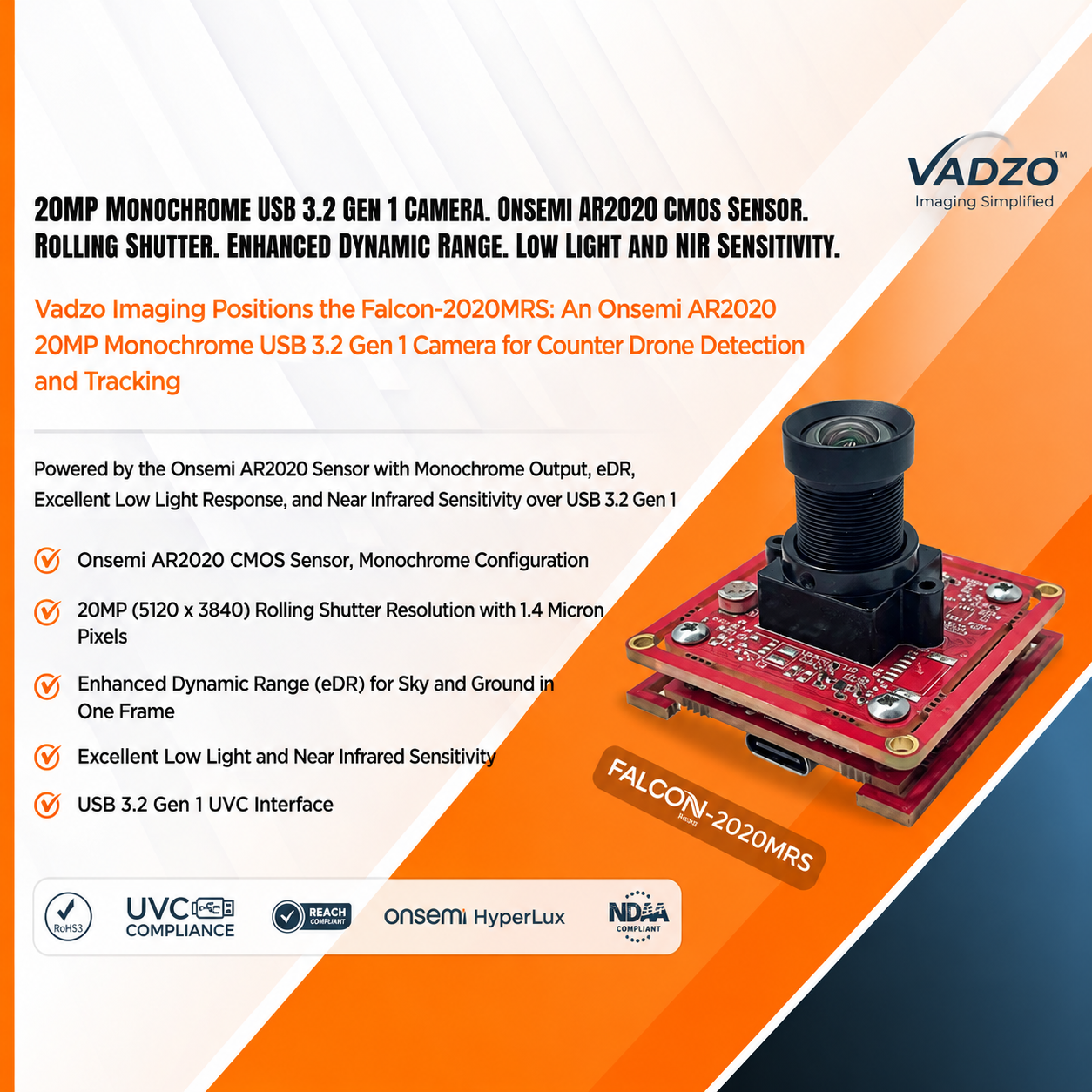
The Falcon-2020MRS is an Onsemi AR2020 20MP Monochrome USB 3.2 Gen 1 Camera, and Vadzo Imaging is positioning it for counter drone detection and tracking.
FORT WORTH, TX, UNITED STATES, November 3, 2026 /EINPresswire.com/ -- Vadzo Imaging, a provider of embedded vision camera products for OEMs and system integrators, positions the Falcon-2020MRS as a 20MP Monochrome USB 3.2 Gen 1 Camera for counter drone detection and tracking. Built on the Onsemi AR2020 sensor, the camera combines monochrome imaging, enhanced dynamic range (eDR), low-light performance, and near-infrared sensitivity in a UVC-compliant module.
Designed for integration into detection and tracking systems, the Falcon-2020MRS provides a high-resolution imaging option for observing small, distant targets. Its monochrome output, 20MP resolution, and USB interface support applications where image detail, light sensitivity, and straightforward host integration are important.
Why a 20MP Monochrome USB 3.2 Gen 1 Camera Suits Counter Drone Detection and Tracking
Small unmanned aircraft can be difficult to detect visually, particularly when flying at a distance against bright skies, clouds, or uneven backgrounds. Their apparent size may be limited to only a few pixels, making image contrast and resolution important for detection and tracking.
Counter-drone systems typically combine multiple sensing technologies. Radar, radio-frequency, and acoustic sensors can help detect or locate potential targets, while cameras provide visual information that operators and image-processing software can use for confirmation and observation. A camera therefore functions as one part of a layered detection system rather than a replacement for other sensors.
Resolution influences how many pixels represent a target. A wide-angle lens covers more of the surrounding area but places fewer pixels across a distant object. A longer focal-length lens places more pixels on the target while narrowing the field of view. Integrators must balance coverage and target detail according to the requirements of the installation.
Lighting and contrast also affect detection. A bright sky, cloud edges, haze, and darker ground can create challenging exposure conditions. At dusk and dawn, low illumination can make targets harder to distinguish as image noise increases with gain. A monochrome sensor with near-infrared sensitivity can support imaging in suitable low-light conditions, particularly when compatible illumination is available.
How the 20MP Monochrome Camera Supports Target Detail
The Falcon-2020MRS uses the Onsemi AR2020, a 20MP monochrome rolling-shutter sensor with a 5120 × 3840 maximum resolution, 1/1.8-inch optical format, and 1.4µm pixels.
Unlike a color sensor with a color filter array, a monochrome sensor allows more incoming light to reach each pixel and does not require demosaicing to reconstruct color information. Each pixel records monochrome intensity directly. This can benefit applications that depend on contrast, edges, and fine image details, particularly when observing small or dim targets.
The sensor also provides low-light response and near-infrared sensitivity across the 850nm and 940nm bands commonly used by near-infrared illuminators. This gives integrators an additional imaging option for suitable dusk, dawn, and illuminated scenes.
Understanding Pixels on Target and Detection Range
The number of pixels covering a target depends on pixel size, lens focal length, target dimensions, and distance. As an example, a 1.4µm pixel used with a 25mm lens covers approximately 56 microradians per pixel. This configuration provides an approximate horizontal field of view of 16 degrees.
For a target measuring 0.4 meters across, an illustrative pixel-on-target calculation gives approximately 2 pixels across the target at 3.6km, 8 pixels at 890m, and 13 pixels at 550m. These estimates represent different levels of target detail, from basic detection to recognition and identification.
These figures are theoretical estimates, not guaranteed operating ranges. Actual results depend on lens performance, atmospheric conditions, haze, target contrast, camera movement, and image-processing methods. A longer focal-length lens can increase the number of pixels on a target but reduces the field of view. Integrators should calculate the expected range using their selected optics and validate it with real targets under representative operating conditions.
Enhanced Dynamic Range and Rolling Shutter
The camera's enhanced dynamic range (eDR) helps capture scenes containing different brightness levels. This can be useful when imaging a bright sky and a darker horizon in the same frame. The eDR mode is intended for scenes with moderate contrast, helping retain useful image information across brighter and darker areas.
The AR2020 uses rolling-shutter readout, in which the sensor captures image rows sequentially. A distant target may move relatively little during the sensor's readout, but movement of the camera mount can affect the image. Fast panning or tilting may introduce skew across the scene.
Integrators can evaluate this effect by testing the camera at the intended mount speeds. Short exposure times and smooth mount movement can help reduce motion-related effects. Applications involving severe or rapid camera movement may benefit from evaluating a global-shutter alternative.
USB 3.2 Gen 1 and UVC Integration
The Falcon-2020MRS connects through a USB 3.2 Gen 1 interface and supports UVC-based integration. This allows compatible host systems to access the camera using standard camera interfaces without relying on a proprietary driver.
A single USB connection carries camera data and power. Integrators should consider cable length, host capability, and the required frame rate when designing the complete system.
A 20MP frame at 8 bits per pixel contains approximately 19.7MB of image data. At 10 frames per second, the uncompressed data rate is approximately 197MB/s before protocol overhead. Higher frame rates may require lower-resolution output or cropped regions, depending on the available camera modes and system configuration. Actual operating modes and frame rates should be confirmed against product documentation and tested with the intended host processor.
Lens Selection and Optical Performance
Lens selection is important when using a 20MP sensor with 1.4µm pixels. The lens must resolve sufficient detail to make effective use of the sensor's resolution. A lens with limited sharpness or contrast can reduce the practical benefit of the high-resolution image.
Longer focal lengths can improve target detail at a distance, but they narrow the field of view and make the system more sensitive to vibration. Atmospheric shimmer can also reduce image clarity over long distances, particularly above hot ground.
Integrators should select a lens based on the required field of view, working distance, and expected lighting conditions. Careful focusing and a stable camera mount are also important during evaluation. Vadzo Imaging can support customers with lens matching and configuration discussions.
Product Overview
The Falcon-2020MRS is a 20MP monochrome USB module built on the Onsemi AR2020 sensor and positioned for counter-drone detection and tracking. As an AR2020 Monochrome USB 3.2 Camera, it gives every pixel a full share of the incoming light, and as a 20MP eDR Mono USB Camera, it keeps a bright sky and a dark horizon readable together. The 20MP Low Light Mono USB Camera designation covers its excellent low-light response, and the 20MP Mono NIR USB 3.2 Gen 1 Camera designation covers its near-infrared sensitivity. The module combines the sensor, a high-performance ISP, and a USB 3.2 Gen 1 interface. It also serves as an AR2020 Rolling Shutter USB 3.2 Gen 1 Camera, a 20MP Enhanced Dynamic Range USB Camera, an AR2020 Low-Light USB 3.2 Gen 1 Camera, a 20MP NIR Sensitivity Mono USB Camera, a 5K Mono NIR USB 3.2 Gen 1 Camera, and an AR2020 Mono eDR USB Camera for designs that need a standard interface.
Key specs: 20MP (5120 x 3840) Max Resolution | Onsemi AR2020 1/1.8 inch Sensor Format | 1.4 micron Pixel | Monochrome with Rolling Shutter | USB 3.2 Gen 1 UVC Interface | S-Mount (M12) Optics
Key Capabilities of the 20MP Monochrome USB 3.2 Gen 1 Camera
Monochrome Imaging
The monochrome sensor records intensity information without a color filter array or color interpolation. This can help preserve image detail and provide useful contrast for detecting small objects against complex backgrounds. Systems that also require color information can evaluate a separate color camera alongside the monochrome module.
Rolling-Shutter Readout
The rolling-shutter architecture supports high-resolution image capture. However, fast camera movement can introduce skew, particularly when the camera is mounted on a rapidly moving pan-and-tilt system. Integrators should evaluate exposure settings and mount movement during system testing.
Enhanced Dynamic Range
The eDR capability helps retain image information in scenes containing both bright and dark areas. Integrators can compare footage captured with eDR enabled and disabled under clear skies, cloud edges, and hazy conditions to determine the most suitable configuration.
Low-Light and Near-Infrared Sensitivity
The sensor's low-light response and sensitivity to 850nm and 940nm near-infrared illumination support evaluation in dim and illuminated environments. Near-infrared illuminators have practical range limitations, so they should not be treated as a substitute for thermal imaging in long-range night detection systems.
High-Resolution Output and USB Connectivity
The 5120 × 3840 output provides detailed image data for applications requiring high-resolution monochrome imaging. USB 3.2 Gen 1 and UVC support simplify integration with compatible host systems. Available output modes and frame rates should be checked during system design.
Counter Drone Detection and Tracking Applications
Detection and Visual Confirmation
The Falcon-2020MRS can serve as a visual camera in systems where radar or other sensors provide an initial cue. Its monochrome output and high-resolution image can support operator observation and software-based target confirmation. Lens selection should reflect the required balance between wide-area coverage and target detail.
Tracking Across the Sky
Once a target has been detected, a tracking system can use camera images to follow its movement. Integrators can evaluate full-resolution and available lower-resolution or cropped output modes according to their frame-rate requirements. Smooth pan-and-tilt movement and suitable exposure settings are important when using a rolling-shutter camera.
Combined Detection and Tracking Systems
Counter-drone installations often require wide-area search followed by closer observation of a selected target. The Falcon-2020MRS can be evaluated for both tasks within a system that uses the full image for searching and an appropriate crop or output mode for tracking. Testing should include the complete optical, mechanical, and processing configuration.
Dusk, Dawn, and Near-Infrared Scenes
The camera's low-light response and near-infrared sensitivity can support imaging in suitable dim-light conditions. Compatible 850nm or 940nm illumination may help in shorter-range applications. For long-range night detection, thermal imaging may serve as the primary imaging technology, with a monochrome visible and near-infrared camera providing additional visual detail and confirmation.
Counter-drone system integrators must also consider the legal and regulatory requirements applicable to detection, recording, and surveillance at their operating locations.
Frequently Asked Questions
Why use a monochrome camera for detecting small drones?
A monochrome sensor does not use a color filter array, allowing more incoming light to reach each pixel. It also records intensity information without color interpolation. These characteristics can help preserve contrast and image detail when observing small targets.
How far can the Falcon-2020MRS detect a drone?
The distance depends on the target size, lens focal length, atmospheric conditions, and the number of pixels required across the target. For example, a 0.4-meter target may cover approximately 8 pixels at around 890 meters with 1.4µm pixels and a 25mm lens under idealized conditions. Actual performance must be validated in the intended environment.
Does the rolling shutter affect drone tracking?
Fast movement of the camera mount can introduce image skew because the sensor reads the image row by row. Short exposure times and smooth mount movement can help reduce this effect. Integrators should test the camera at the intended pan-and-tilt speeds.
Can a near-infrared camera replace thermal imaging at night?
No. Near-infrared sensitivity and compatible illumination can support imaging in suitable conditions, but illuminator range is limited. Thermal imaging may be more appropriate as the primary sensor for long-range night detection.
Why choose Vadzo Imaging for a 20MP monochrome USB camera?
The Falcon-2020MRS combines a 20MP monochrome sensor, enhanced dynamic range, low-light response, near-infrared sensitivity, and USB 3.2 Gen 1 connectivity. Vadzo Imaging also supports integration discussions involving lens selection, firmware customization, and enclosure design. Evaluation options allow customers to assess the module within their intended system.
Availability
The Falcon-2020MRS 20MP Monochrome USB 3.2 Gen 1 Camera, built on the Onsemi AR2020 sensor, is available for evaluation and production orders. Evaluation kits include the camera module, an S-Mount lens, a USB cable, and platform documentation, with no minimum order requirement.
Integrators can evaluate the camera with their selected lens, test eDR under different lighting conditions, and assess tracking performance on their intended mount. For evaluation requests or OEM integration discussions, contact Vadzo Imaging at support@vadzoimaging.com or visit the Vadzo Imaging website.
About Vadzo Imaging
Vadzo Imaging is a global provider of embedded vision solutions, offering camera technologies and imaging platforms for robotics, industrial automation, UAVs, edge AI, and medical systems. Its products are designed for integration with leading embedded platforms. Vadzo supports customers through hardware customization, firmware development, and module-level drivers across USB, MIPI, GigE, Wi-Fi, and SerDes camera interfaces.
Alwin Vincent
Vadzo Imaging
+1 817-678-2139
alwin@vadzoimaging.com
Visit us on social media:
LinkedIn
YouTube
X
Legal Disclaimer:
EIN Presswire provides this news content "as is" without warranty of any kind. We do not accept any responsibility or liability for the accuracy, content, images, videos, licenses, completeness, legality, or reliability of the information contained in this article. If you have any complaints or copyright issues related to this article, kindly contact the author above.
